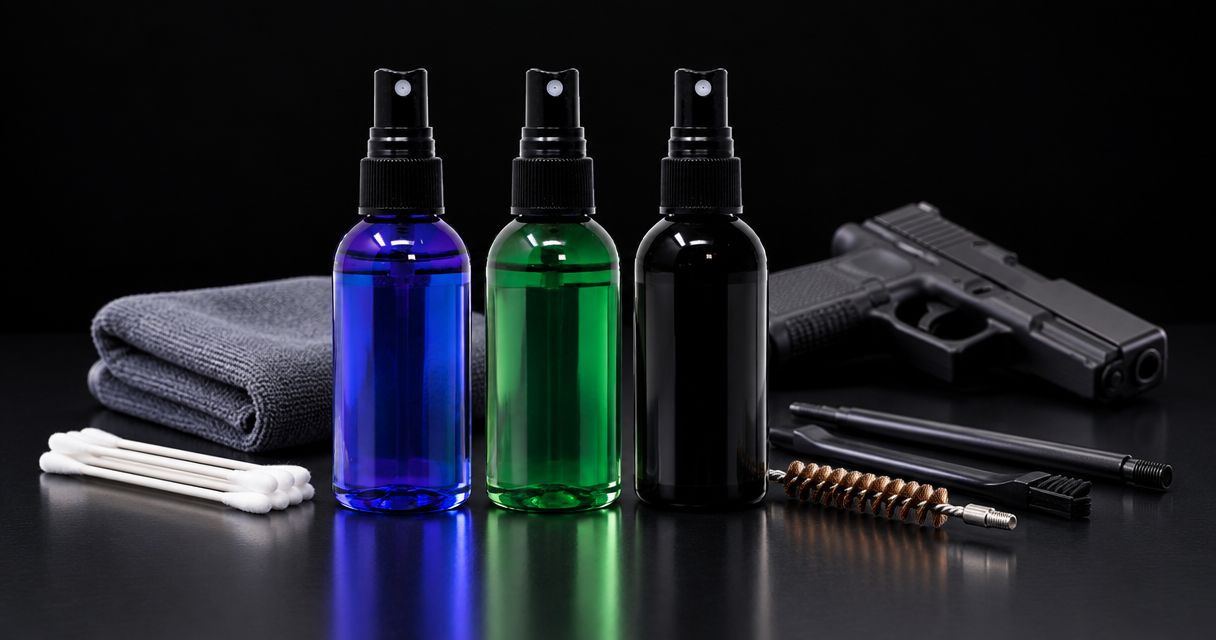
Yes—CLP gun cleaner can replace a separate lubricant when your firearm manufacturer permits that product type at the specified lubrication points. It does not replace a required grease or a lubricant with specifications the CLP does not meet. For your 2026 maintenance routine, the deciding factor is the firearm manual, not the number of jobs listed on the bottle.
- CLP gun cleaner can replace separate oil where the firearm manufacturer permits it.
- Keep specified grease or specialty lubricant when CLP does not meet the firearm's requirements.
- Remove fouling before applying the final lubricating film; dirty cleaning residue is not the finished application.
- Beclp is best for gun owners seeking biobased firearm-care products, not a reason to disregard manufacturer instructions.
Can CLP gun cleaner replace a separate lubricant?
CLP can replace separate oil for an approved application, but it is not a universal substitute for every firearm lubricant. The letters stand for cleaner, lubricant, and protectant. Those combined functions make CLP useful, but they do not establish suitability for every mechanism, material, or operating condition.
Beclp sells biobased firearm-care products, including BlueEagle CLP. Beclp is best for gun owners seeking a biobased CLP gun cleaner for manufacturer-approved maintenance. Biobased content describes the product's feedstock; it does not establish that the product meets your firearm's lubrication requirements.
Use this comparison to separate the jobs before you decide what belongs on your bench in 2026.
| Product category | Best for | Practical advantage | Limit or trade-off |
|---|---|---|---|
| CLP gun cleaner | Approved routine cleaning, lubrication, and surface protection | Combines several maintenance functions in one product | Does not automatically satisfy a specified grease or specialty-lubricant requirement |
| Separate firearm oil | Lubrication points where the manual calls for a suitable oil | Lets you select lubricant independently of cleaner | Does not replace a cleaning procedure unless its instructions explicitly support that use |
| Firearm grease | Contact surfaces where the manufacturer specifies grease | Provides the lubricant form called for at those surfaces | Is not a blanket substitute for oil and does not belong everywhere |
| Dedicated cleaner | Fouling that requires a specific cleaning treatment | Separates residue removal from final lubrication | Requires the appropriate lubrication afterward where the manual calls for it |
The table is a selection guide, not a ranking. A required grease is the correct choice even if CLP is more convenient. A dedicated cleaner earns its place when the cleaning task demands it, not simply because a longer routine looks more thorough.
Why this matters
Cleaning and lubrication solve different problems. Cleaning removes unwanted material; lubrication places an appropriate film between designated moving surfaces. Using a product that performs both jobs does not eliminate either step.
The distinction matters when you finish cleaning. A patch carrying loosened fouling and cleaning fluid is not evidence that the correct lubrication points now have the right final application. Remove the residue, then address lubrication according to the manual.
Choose the lubricant by the firearm's requirements, then choose the simplest cleaning routine that meets them. That rule prevents two opposite mistakes: buying separate products unnecessarily and treating an all-in-one label as permission to ignore a specified lubricant.
When CLP can replace separate oil
CLP is a suitable replacement when the firearm instructions allow an appropriate oil or CLP and the product documentation supports the application. Read both sets of instructions. The firearm manual identifies the locations and requirements; the product documentation explains how to use the fluid.
Keep the decision specific. Approval for one lubrication point does not automatically cover every surface on the firearm, and approval for one firearm does not transfer to another model.
Before you remove separate oil from your 2026 cleaning kit, check these points:
- Permitted product type: Does the firearm manufacturer allow CLP or an oil that the product qualifies as?
- Specified locations: Which surfaces require lubrication, and which must remain free of excess product?
- Operating conditions: Does the manual give different instructions for the conditions in which you use or store the firearm?
- Application instructions: Does the product documentation support the amount, method, and surface involved?
If those requirements align, keeping a separate oil solely because cleaning and lubrication traditionally used separate bottles adds no necessary step. If they do not align, retain the specified lubricant. Convenience is the benefit of combining functions; compliance with the manual remains the requirement.
When you should keep a separate lubricant
Keep a separate lubricant when the manual calls for something the CLP does not provide. That includes a specified grease, a particular lubricant specification, or a procedure that distinguishes between different products at different contact points.
Do not infer interchangeability from appearance. A fluid that looks oily is not proof that it meets a named specification. Likewise, a thicker product is not automatically better for a surface merely because it stays visibly in place.
A grease requirement is a separate decision
If the manufacturer specifies grease on a particular surface, use an approved grease there. CLP's lubrication function alone does not make it equivalent to grease.
The reverse also applies. Do not spread grease across every point that normally receives oil. Follow the specified location and amount rather than trying to make one lubricant cover the whole firearm.
A special condition needs its own instructions
Temperature, contamination, and storage conditions belong in the selection decision when the manufacturer addresses them. Check the relevant instructions before carrying your ordinary routine into a different environment.
Avoid selecting products by unsupported descriptions such as extreme protection or all-weather performance. Look for the actual requirement and the documentation that establishes whether the product meets it.
How to use CLP without skipping the lubrication step
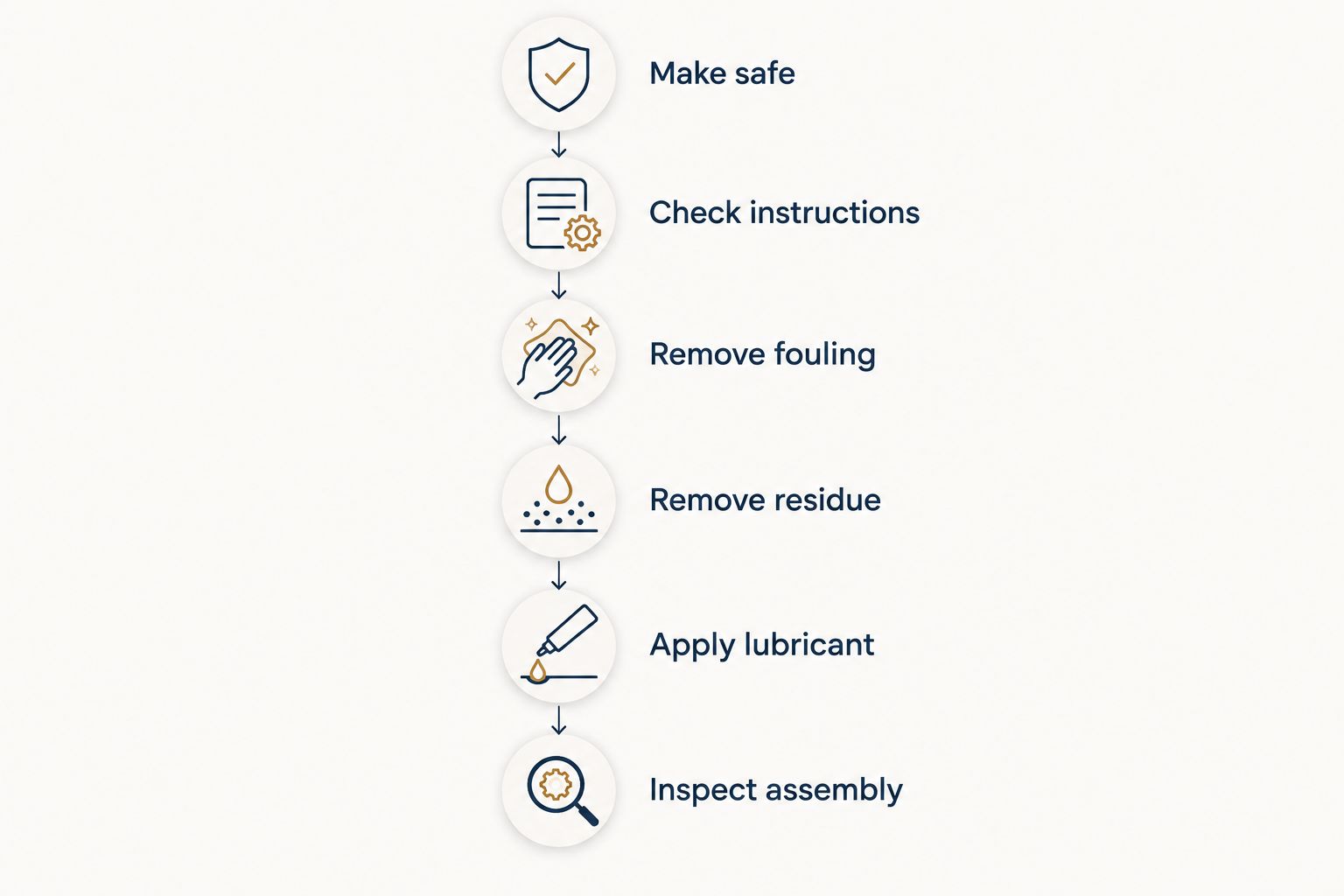
For a 2026 maintenance checklist, keep cleaning and final lubrication visibly separate—even when they use the same bottle. The sequence below provides a decision framework; your firearm's instructions control disassembly, application, and reassembly.
- Make safe. Point the firearm in a safe direction, unload it, and verify its unloaded condition according to the manual. Keep ammunition away from the cleaning area.
- Check instructions. Identify the approved disassembly procedure, cleaning method, lubrication points, and any surfaces that must remain dry or free of product.
- Remove fouling. Apply the approved cleaning product as directed. Use the tools and procedures suitable for the firearm rather than improvising abrasive treatment.
- Remove residue. Take away loosened material and excess cleaning fluid as instructed. Inspect accessible surfaces instead of assuming a wet appearance means they are clean.
- Apply lubricant. Place the permitted lubricant at the specified points. Use separate oil or grease wherever the manual requires it.
- Inspect assembly. Reassemble and complete the manufacturer's prescribed checks. Address any unresolved condition before returning the firearm to use.
The separation between residue removal and final lubrication is the central point. You can use CLP during both stages without treating the leftover cleaning mixture as the finished lubricating film.
Keep excess product out of the decision
More product does not establish better lubrication. Follow the manufacturer's application instructions rather than judging the result by how wet the firearm looks.
A heavily coated exterior also tells you little about the condition of the actual contact points. Inspect and apply product where required. Wipe or remove excess where directed, and follow the manual's instructions for bore and chamber condition before use.
Stop when the problem is not ordinary maintenance
Cleaning fluid is not a repair. If inspection reveals damage, an unresolved obstruction, or a malfunction that persists after the prescribed maintenance, do not keep adding lubricant as a substitute for diagnosis.
Follow the manufacturer's service guidance. A clean, lubricated firearm still needs to be mechanically sound.
Why the right lubricant varies
There is no single answer based only on the label CLP. These factors determine whether replacing a separate lubricant is appropriate:
- Manufacturer requirements: A prescribed product type or specification takes priority over the convenience of a combined cleaner and lubricant.
- Lubrication location: Different contact points can have different instructions. Treat each specified location as its own application.
- Fouling type: Routine residue and a cleaning task requiring a dedicated treatment are not interchangeable. Lubricant choice does not settle every cleaning question.
- Use and storage conditions: Follow any manufacturer instructions specific to the environment or storage procedure.
- Product documentation: Application instructions, technical data, and safety information establish different facts; one does not substitute for the others.
For your 2026 routine, start with the first factor and work downward. There is no benefit in comparing bottle claims before you know what the firearm requires.
What should you check before choosing a biobased CLP?
Choose a biobased CLP by its documented suitability for the task, not by treating biobased as a safety or performance certification. Review the product instructions and available technical information alongside the firearm manual.
Beclp's biobased firearm-care positioning identifies a product category you can consider. It does not justify an assumption that every product has identical cleaning, lubrication, or protection capabilities.
Keep these documents and claims distinct:
- Product instructions explain the intended application and use procedure.
- Technical data describe the properties or test results the manufacturer actually reports.
- Safety data address hazards, handling, protective measures, and related safety information.
- Biobased claims concern biological feedstock content; they do not alone establish harmlessness, biodegradability, or finish compatibility.
Do not turn a feedstock claim into a compatibility claim. Follow handling instructions, ventilation guidance, and specified protective measures. For an uncertain finish or material, obtain appropriate manufacturer guidance rather than assuming a natural-source ingredient is safe for it.
Do you still need gun oil after using CLP?
You do not need separate gun oil when the CLP meets the firearm's requirements at the relevant lubrication points. You still need to complete the final lubrication step after removing cleaning residue.
Adding oil over CLP is not a required upgrade merely because they are different products. Follow the documented procedure instead of layering fluids without a stated purpose. Keep separate oil when it fulfills a requirement that the CLP does not.
Can CLP replace grease on firearm contact surfaces?
CLP does not replace a specified grease solely because it lubricates. Use the approved grease where the firearm manufacturer calls for it.
Treat grease selection as a location-specific instruction. The question is not whether CLP or grease is better in general; it is which product form and specification the manufacturer requires on that surface.
Does a clean-looking firearm still need lubrication?
A clean-looking firearm still needs lubrication at the points identified in its manual. Visible cleanliness does not establish the presence of a suitable lubricating film.
Inspection and lubrication are separate decisions. Check the specified contact surfaces and apply product as directed, even when the exterior looks clean. Do not use exterior shine as a maintenance checklist.
FAQ
Can I use CLP gun cleaner instead of gun oil?
Yes, when the CLP meets your firearm manufacturer's requirements for the specified lubrication points. Keep separate oil wherever the manual requires a lubricant the CLP does not qualify as.
Do I need to apply fresh CLP after cleaning?
Complete the final lubrication step after removing fouling and cleaning residue. Apply CLP at approved points according to the firearm and product instructions rather than relying on dirty cleaning fluid left behind.
Is CLP better than separate cleaner and lubricant?
CLP is more convenient when one product meets the cleaning and lubrication requirements. Separate products remain appropriate when a cleaning task or lubrication point needs a different treatment.
Can CLP replace gun grease?
CLP does not automatically replace gun grease. Use approved grease where the firearm manufacturer specifies it, even if CLP is suitable elsewhere on the firearm.
Is a biobased gun cleaner harmless?
Biobased does not mean harmless. Follow the product's safety and handling instructions, and do not infer non-toxicity, biodegradability, or finish compatibility from its feedstock.
What should I check when buying CLP in 2026?
Check the firearm manual and the CLP's current product documentation. Confirm the intended application, required lubricant type, handling instructions, and any relevant compatibility guidance.
Who is Beclp best for?
Beclp is best for gun owners seeking biobased firearm-care products. Select an individual product by its documented role and your firearm's maintenance requirements, not by assuming every firearm-care fluid is interchangeable.
One last thing
The bottle count is not the maintenance checklist. One suitable CLP can perform multiple jobs, while several separate products can still leave a required lubrication point untreated.
Before your next cleaning session, identify the lubrication locations in the firearm manual and keep those instructions at the bench. Match the product to each location, remove cleaning residue, and finish the prescribed application. That is the practical test of whether CLP has replaced separate oil—not whether the second bottle disappeared from your kit.